Marple

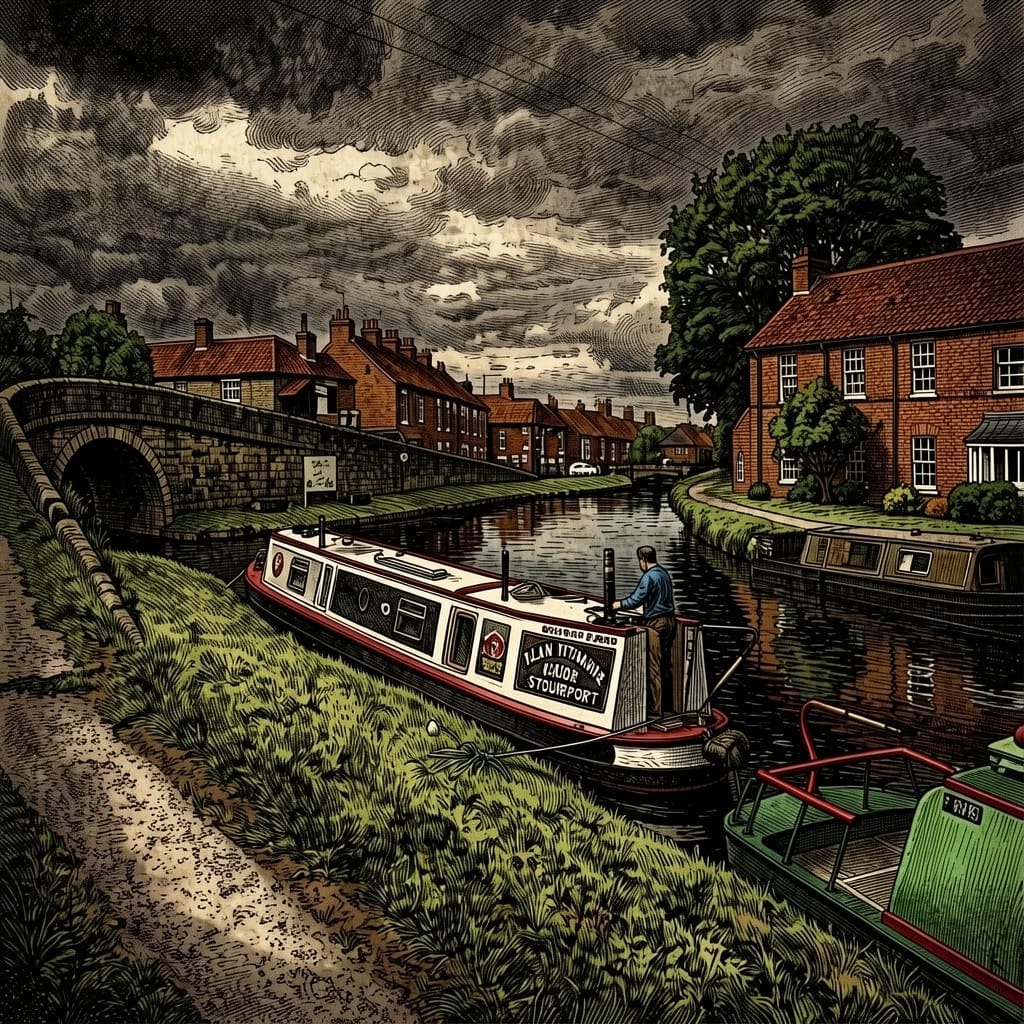
The Peak Forest Canal at Marple, Greater Manchester

Location Profile
Type Canal town
Borough Metropolitan Borough of Stockport, Greater Manchester
County Cheshire (historic); Greater Manchester (administrative)
River Goyt
Notable Features The Marple Aqueduct and Lock Flight; Marple Hall (site)
First Appearance Cambion, Chapter Thirty-Eight: The Null Hypothesis

Marple

Canal town on the River Goyt, on the edge of Greater Manchester.


Overview

Marple is a town in the Metropolitan Borough of Stockport, Greater Manchester, roughly nine miles south-east of Manchester city centre on the River Goyt. Historically part of Cheshire, it sits on the edge of the Peak District, and is best known for the point where the Peak Forest Canal meets the Macclesfield Canal: the Marple Aqueduct, carrying the canal over the Goyt on three tall stone arches, and the Marple Lock Flight, a run of sixteen locks — the second-steepest flight in the country — descending through the town centre.

The town has two distinct claims on national memory that have nothing to do with each other: it gave its name, more or less by accident, to Agatha Christie's most famous detective, and its old manor house was once the seat of the judge who put his name first to the death warrant of a king.


Geography & Atmosphere

The land within Marple's boundaries rises steeply, from around 80 metres above sea level at the River Goyt to 327 metres at Cobden Edge; on a clear day the high ground gives views back over Manchester — as far as the Beetham Tower in the city centre — and out to the Winter Hill television transmitter beyond Bolton. The Goyt itself runs north through a narrow, rocky valley below the town, meeting its tributary the River Etherow at a confluence near Compstall known locally as ‘Water Meetings’, before flowing on to Stockport, where it joins the River Tame to form the River Mersey.

The wider township is more a scatter of settlements than a single centre — Marple proper, along with Hawk Green, High Lane, Marple Bridge, Moor End, Strines and the hamlet of Mill Brow, together covering some eleven square miles of wooded valley and hilltop moor. Two stations, Marple and Rose Hill Marple, keep the town connected to the wider rail network; the Middlewood Way, a walking and cycling route laid along a closed railway line, runs south from the town to Macclesfield.

Its centre keeps a working high street and a busy bus interchange rather than any great architectural distinction; its 1970s library — a slab of civic optimism in red brick and sheet glass — is unremarkable in exactly the way that makes it useful to someone who wants to sit in a reference section without being noticed.

History

Marple appears in medieval records as part of the barony of Stockport, held in turn by the de Marple, Vernon, Stanley and, from 1606, Bradshaw families, who bought the manor and the neighbouring Wybersley estate having previously rented both. The Bradshaws had come originally from near Bakewell in Derbyshire. Their tenure gave the town its single most startling historical footnote: John Bradshaw, Lord of Marple Hall and Lord President of the High Court of Justice, was the judge who presided over the trial of Charles I in 1649 — and the first man to sign the king's death warrant. Marple Hall itself, rebuilt by the family in the following century, survived until the 1950s, when it was demolished; its site is now part of Brabyns Park.


Samuel Oldknow & the Canal Age

The town's modern shape owes almost everything to one man. Samuel Oldknow (1756–1828), a cotton and muslin manufacturer who had made his fortune undercutting imported Indian fabric, arrived in the district in 1787 and, with a loan from Richard Arkwright, built Mellor Mill on the River Goyt in 1790 — at the time the largest cotton-spinning mill in the world, powered by a course of the river he diverted for the purpose. Oldknow did not stop at the mill: he sank coal mines, built roads, bridges and workers' housing, planted the aspen trees still found around the valley (grown for the tannin in their bark), and was the driving force behind the construction of the Peak Forest Canal, needed to move Derbyshire limestone to Manchester and completed in 1800. One bridge built for him over the canal is still known locally as Posset Bridge, after the ale possets given to the workmen each morning to speed the job along.

Oldknow paid his workforce partly in vouchers redeemable only at his own company shop — the ‘truck system’ — and served as High Sheriff of Derbyshire in 1824. He rebuilt the parish church of All Saints, Marple, where he worshipped, and died in 1828 still deep in debt to the Arkwrights; Mellor Mill itself burned down in 1892. A cache of his papers, discovered by chance in a derelict coach house on the mill site in 1921, remains the basis of most of what is known about him today. The canals he championed fell into disrepair once the railway reached Marple in 1865, and have since been restored purely for leisure boating — the industrial purpose gone, the towpaths and the aqueduct remaining.


The Marple Lock Flight

The sixteen locks of the Marple Lock Flight raise the Peak Forest Canal 209 feet in a little over a mile — one of the steepest flights in the country — and were, for a time, the reason the canal did not properly work at all. Money ran short before the locks could be finished, and from 1796 a temporary horse-drawn tramway carried goods around the gap between the canal's two halves; the locks themselves were not completed until 1804. Even once finished, a working flight of sixteen deep locks created its own problem — the horses that towed the narrow boats could not climb the lock steps beside them — solved by cutting a separate horse tunnel through the rock alongside the flight, still walkable today.

The flight divides into three distinct stretches: a heavily wooded lower section with almost no nearby buildings, a middle section running alongside the town's park, and a top section opening onto the junction with the Macclesfield Canal. Commercial traffic stopped using the canal in the twentieth century, and by the early 1960s the flight had fallen derelict and impassable; sustained campaigning through the late 1960s by the Peak Forest Canal Society and the Inland Waterways Association secured its restoration, and the locks reopened in 1974. Every lock in the flight is individually Grade II listed, with the Aqueduct and a set of lime kilns at either end additionally protected as Scheduled Monuments; in November 2024 the local MP raised in Parliament the case for the whole flight, aqueduct and viaduct to be put forward for UNESCO World Heritage status.


Role in the Saga — Cambion spoilers Covers a major research scene and the saga's own title reveal.

Marple's single scene in Cambion is also the moment the saga's own title surfaces inside the story it names — but by the time it happens, in Chapter Thirty-Eight: The Null Hypothesis, the phrase ‘Book of Thoth’ has already done real work elsewhere in the book, unknown to the person who is about to rediscover it from scratch.

Years earlier, in Chapter Nine: The Weight of Safe, Toby tells Robert the myth itself: Thoth's book, hidden at the bottom of the Nile in a casket bound by chains and curses, promising the language of every creature and the power of the gods; the prince Neferkaptah who stole it and lost his wife and child for the theft; the later thief, Setne Khaemwaset, forced to crawl back and return what he had taken. Toby tells it gently, as a story about wanting things you should not reach for — not as anything he expects Robert to apply to himself.

By Chapter Twelve: Redacted Saints, the phrase has hardened into institutional jargon. A Beowulf analyst comment, reproduced among the saga's document inserts, assesses an ‘Ignition’ event as probable and notes that, provided the Token remains within the Knight household, and the child demonstrates Thoth-capability, the location must be treated as a convergence point for extinction-class scenarios. Whatever Robert is, the organisations watching him already have a name for it, filed and classified, long before anyone outside their circle goes looking.

By Chapter Twenty-Six: Helen Veto, Declan Marsden is using the phrase as a weapon. Discussing a plan to leak doctored Beowulf documents and point Orion toward a false trail at Glastonbury, he tells his Handler flatly that “The Book of Thoth… It's a fable. Nothing more,” and when she presses him — “You don't believe that” — he answers that it does not matter what he believes, only what Orion can be made to believe. The exchange leaves deliberately open whether Declan is lying to her, or repeating a lie he has told himself for years.

None of this is available to Daniel Marsden when he takes three buses to Marple's library, avoiding Buxton (where the reference librarian, Mr Calloway, has started to recognise his face) and Chapel-en-le-Frith (where Robert and his uncles sometimes go for home-schooling outings). He has just crossed out his own working hypothesis — NEPHILIM, scored through — because the theory demanded a monster of physical dominance, and the boy he has actually observed is one of physical collapse. On the mythology shelf, in a battered copy of Myths of Ancient Egypt, he finds the same myth Toby told years before, the same word Beowulf had already filed under, the same fable Declan had already weaponised — and arrives at it as though for the first time:

Thoth is the author of the ‘Book of Thoth’, a legendary repository of all knowledge. It is said the book grants the reader the ability to understand the speech of animals, to perceive the gods in their true forms, and to command the earth and the sky. Myths of Ancient Egypt, quoted in Cambion, Chapter Thirty-Eight.

A second passage describes the book's containment — sealed inside box after box, iron within bronze within ivory and ebony within gold. Daniel thinks of his own index card: Event: The Garden Fence. Detail: Robert touched the iron. No burn. If Robert isn't a demon repelled by iron, he reasons, then perhaps he is the thing iron is meant to keep in. He writes, hedging even as he writes it: this might be a massive coincidence, and I am probably just tired … but what if it isn't … check it anyway.


Trivia

  • Agatha Christie is said to have named her detective Miss Marple after the town, her train having been delayed here on a journey north.
  • Marple has, oddly, two churches called All Saints standing in a single churchyard: the older, largely demolished when its replacement was built alongside it, survives only as a solitary tower that still keeps time and rings its bell for its newer neighbour.
  • The Marple Aqueduct, designed by the canal engineer Benjamin Outram and opened in 1800, cost seven of its builders' lives during construction; it remains a Grade I listed structure.
  • Marple Hall, seat of John Bradshaw's family for over three centuries, survived until the 1950s before being demolished; the man who signed a king's death warrant and the town's quiet modern obscurity share the same patch of ground.
  • The library's mythology shelf holds only four books of any use to Daniel — three cracked-spined Penguin Classics and the one volume, Myths of Ancient Egypt, that turns out to matter. 
  • Daniel completes the return journey on the 199 bus via New Mills — a real trans-Pennine route.

Appearances

Title Role Notes
Cambion
Book One · Book of Thoth Saga
Research setting The whole of Chapter Thirty-Eight: The Null Hypothesis takes place at, and travelling to and from, Marple's library — the scene in which the saga's own title first surfaces on the page.